Need support?
Contact us by email directly
Send us your details and we’ll get back to you with availability, pricing, and any additional information you need.

Advantages
Broad Wavelength Coverage: 190nm–1700nm
Highly Matched PD Pairs: Eliminates common-mode noise
High Gain (10⁴ V/W), High Bandwidth (1MHz–1GHz)
Free-Space/Fiber Optic Inputs: Flexible installation with versatile accessories
4-Step Gain Adjustment (0–30dB): (Customizable to 8 steps)
Compact & Robust Design: Ideal for diverse applications
Selectable Photosensitive Area: 80μm–10mm
USB (Type-C) Power / SMA Outputs
Product Applications
Wavelength coverage: 190–1700 nm
The DL/PDB series balanced detectors cover the ultraviolet, visible, and near-infrared spectral ranges. The detectors use high-quality silicon (Si)-based photodiodes (PDs) to cover optical signals in the 320nm-1100nm wavelength range, and photodiodes made of conventional indium gallium arsenide (InGaAs) materials to cover optical signals in the 800-1700nm wavelength range. This meets the diverse detection needs of different applications and provides a wider range of detection options for numerous photoelectric conversion scenarios in scientific research and industry

Highly matched dual PDs, eliminating common-mode noise and achieving high common-mode rejection ratio (CMRR)
The Dimension-Labs Balanced Photodetector PDB eliminates common-mode noise by amplifying and then differentially processing two input optical signals. Each detector utilizes two well-matched Si or InGaAs photodetectors and an ultra-low noise transimpedance amplifier, combined with a differential circuit. This configuration cancels out non-uniformities and differences in light source intensity and photodiode performance, thereby enhancing the detector's sensitivity and anti-interference capabilities. It achieves a Common-Mode Rejection Ratio (CMRR) of Min >25dB (Max <35dB).

High gain, high bandwidth, and low noise
The DL/PDB series balanced detectors developed by Dimension-Labs are equipped with built-in low-noise and high-gain transimpedance amplifier circuits (TIA), which can convert and amplify the photocurrent through TIA with a gain range of (1×10³ V/W) to (1.75×10⁵ V/W). Various models cover a bandwidth range of 1MHz to 1GHz, and can restore optical signals with minimal distortion under high-gain conditions, greatly enhancing the detection capability for weak optical signals. The detection sensitivity can reach up to -75dBm, and the noise of all gain levels is as low as 5.0mV or below.

Flexible installation with fiber optic/free-space optical combination accessories
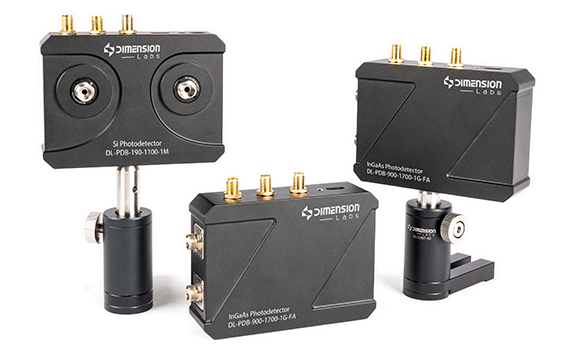
Dimension-Labs presents both fiber-optic input models and versatile models supporting seamless switching between free-space and fiber-optic inputs, tailored to diverse application scenarios. The fiber-optic balanced detectors feature two fiber input ports (Input+ and Input-), enabling direct connection to various fiber interfaces such as PC/APC for transmitting optical signals. Three SMA outputs provide common-mode signals and two monitor channels (MONITOR+ and MONITOR-) for real-time signal monitoring

The free-space optical balanced detector is equipped with two spatially symmetric detectors on its front panel, aligned along the central axis. The outer part features SM1 external threads and SM05 internal threads, which can be combined with fiber flanges via these threads to switch to fiber input. Additionally, for high-power laser detection scenarios requiring attenuation, it can be used with neutral density filters, ensuring simple operation and easy installation.

Dimension-Labs has designed the spacing between the free-space optical balanced detectors to be 50mm, which exactly matches the hole pitch of standard optical platforms. This thoughtful design simplifies beam alignment during free-space optical path adjustments, significantly enhancing the efficiency of optical path tuning in experimental setups

Compact and exquisite in appearance, suitable for a wide range of scenarios
The detector's housing measures just 80mm × 65mm × 20mm, enabling it to be integrated into most locations within optical systems. This compact design addresses the challenge of embedding detectors in small, complex systems, thereby expanding its applicability across diverse scenarios. The indicator lights on the DL/PDB series detectors use illumination and color changes to signify operational status: When connected via TYPE-C, the green LED indicates power-on and normal startup.

4-level adjustable gain
The adjustable-gain balanced detectors are designed with flexibility in mind, offering multiple selectable gain settings for versatile applications. Within the amplified signal range, four adjustable gain levels (0–30dB, 10dB steps) are provided while maintaining optimal common-mode rejection ratio (CMRR) performance. This multi-level adjustment simplifies operation and suits both industrial and scientific research applications across various fields. Users can tailor the gain and bandwidth to their specific scenarios, maximizing utility and significantly enhancing practicality.

More convenient USB-Type-C power input and SMA signal output
In contrast to other manufacturers' amplified detectors that require separate DC power supplies, Dimension-Labs has revolutionized the industry by introducing a USB power interface. The DL-PDB series balanced photodetectors operate on 5V via a USB-Type-C power input, and each unit comes pre-configured with a USB-Type-C power cable and SMA-to-BNC adapter cables. This allows direct powering from common smartphone chargers, while the three SMA outputs enable easy access to common-mode signals and individual PD monitoring signals via oscilloscopes, enhancing usability for both researchers and industrial users.

| Model | DL-PDB-400-1100-1M-A |
|---|---|
| Wavelength Range (nm) | 400-1100 |
| Material Type | Si |
| Connector Style | Free-space / Fiber-optic |
| Peak Responsivity (A/W) | 0.52@850nm |
| 3dB Bandwidth (MHz) | DC-1 |
| Photosensitive Area Diameter (mm) | 3.2 |
| Gain (V/W) | 6.2×10^5 |
| Response Time (ns) | 350 |
| Operating Voltage (V) | 5 |
| Input | FC/free-space optical |
| Output Impedance (Ω) | 50 |
| Noise Equivalent Power (pw/√Hz) | 50 |
| Output Coupling Mode | DC |
| Saturated Optical Power (dBm) | 9.0 (8mW) |
| Amplification Function | yes |
| Common Mode Rejection Ratio (dB) | 35 (typ.) |
| Operating Current (A) | 0.5 |
| Output | SMA |
| With or Without Monitoring Output | With |
| Model | DL-PDB-800-1700-5M-A | DL-BPDI-1200-1700-1.6G-E | DL-BPDI-900-1400-1.6G-E |
|---|---|---|---|
| Wavelength Range (nm) | 800-1700 | 1200-1700 | 900-1400 |
| Material Type | InGaAs | ||
| Connector Style | Free-space / Fiber-optic | FC Fiber | FC Fiber |
| Peak Responsivity (A/W) | 0.9@1550nm | 0.9@1550nm | 0.7@1064nm |
| 3dB Bandwidth (MHz) | DC-5 | 500K-1.6G | 500K-1.6G |
| Photosensitive Area Diameter (mm) | 2 | ||
| Gain (V/W) | 1.2×10^6 | 1.6×10^4 | 1.1×10^4 |
| Response Time (ns) | 70 | 0.2 | 0.2 |
| Operating Voltage (V) | 5 | DC±12 | DC±12 |
| Input | FC/free-space optical | FC | FC |
| Output Impedance (Ω) | 50 | ||
| Noise Equivalent Power (pw/√Hz) | 40 | 10 | 10 |
| Output Coupling Mode | DC | AC | AC |
| Saturated Optical Power (dBm) | 5.7 (3.75mW) | -0.97 | 0 |
| Amplification Function | yes | ||
| Detects Analog Optical Signals | no | no | |
| Common Mode Rejection Ratio (dB) | 30 (min.) | >25 | >25 |
| Operating Current (A) | 0.5 | 0.35 | 0.35 |
| Output | SMA | ||
| With or Without Monitoring Output | With | Can be Selected | Can be Selected |
| Model | DL-BPDI-500-880-1.6G |
|---|---|
| Wavelength Range (nm) | 500-880 |
| Material Type | GaAs |
| Connector Style | FC Fiber |
| Peak Responsivity (A/W) | 0.5@850nm |
| 3dB Bandwidth (MHz) | AC1.6 GHz |
| Gain (V/W) | 6.5×10^3 |
| Response Time (ns) | 0.2 |
| Operating Voltage (V) | DC±12 |
| Input | FC |
| Output Impedance (Ω) | 50 |
| Output Coupling Mode | AC |
| Saturated Optical Power (dBm) | -7 |
| Amplification Function | yes |
| Detects Analog Optical Signals | no |
| Common Mode Rejection Ratio (dB) | 30 (min.) |
| Output | SMA |